procrastinate
відкладати на потім in this sentence
also: зволікати · баритися
To delay or postpone doing something, especially out of laziness or avoidance.
How it works
1
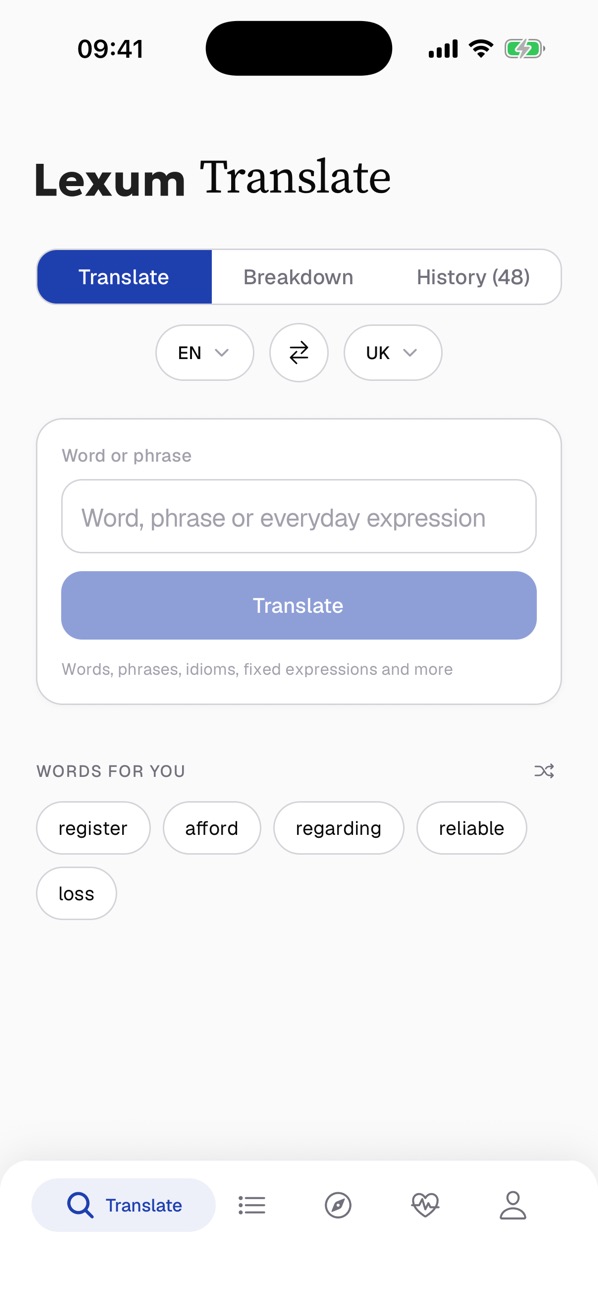
Type it, paste a passage or photograph a page. A single word, a phrase, a whole article.
2
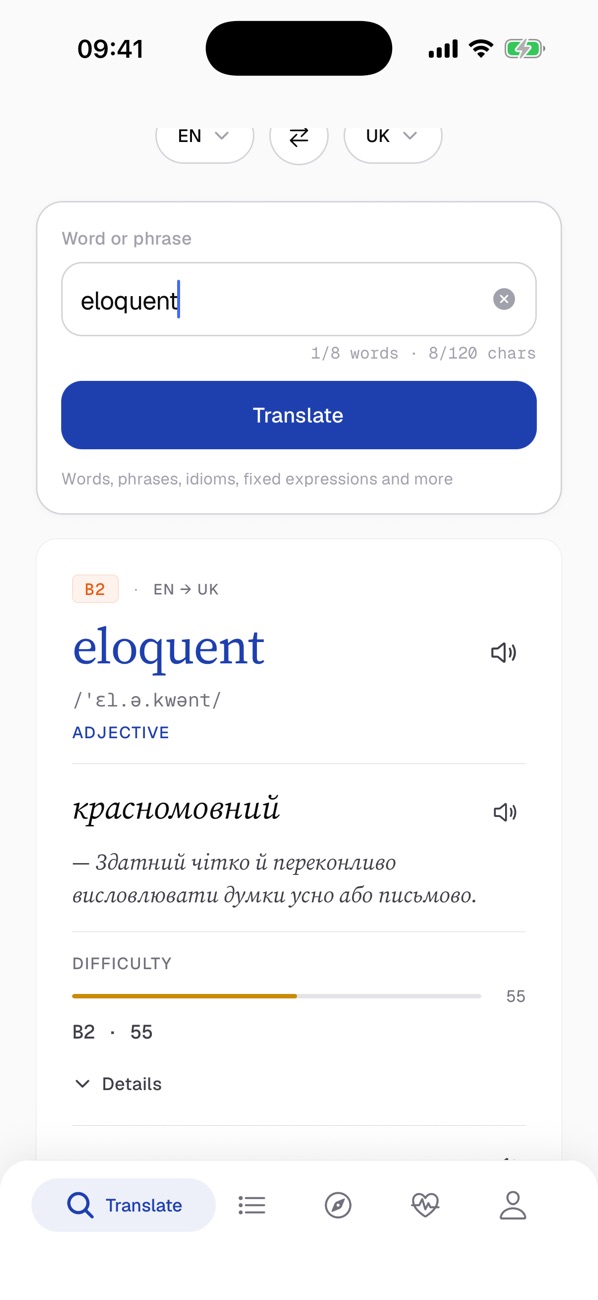
The meaning it has in this sentence, not the first line of a dictionary. Its level, pronunciation, other meanings — and whether it's an idiom that mustn't be read literally.
3
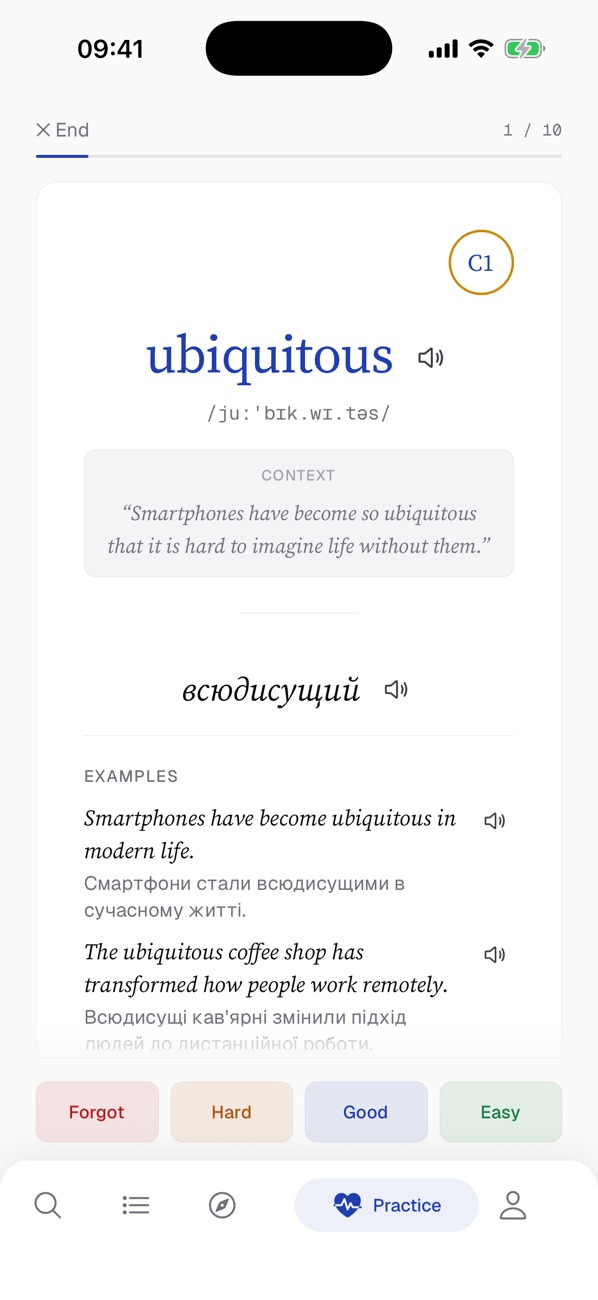
Saved words go into your daily plan. Five practice modes, scheduled by FSRS, so a word returns when you're about to lose it.
Breakdown
A book, a menu, a work email, a screenshot. Lexum reads the text and picks out the words worth learning at your level — and lets you tap any other word too.
Try it here
Photo of a page
Most of us on the part of learning a language. We read an article, meet an phrase and look it up. But the memory is : a week later the word is gone, as if we had never seen it.
1 more word is outside this level — tap it to add
Tap any underlined word · ▸ translates the sentence
відкладати на потім in this sentence
also: зволікати · баритися
To delay or postpone doing something, especially out of laziness or avoidance.
нудний in this sentence
also: монотонний
Boring and tiresome because it is too slow, long, or repetitive.
виразний in this sentence
also: красномовний · переконливий
Clearly and effectively expressing ideas or feelings through language or gesture.
короткочасний in this sentence
also: ефемерний · недовговічний · минущий
Lasting for only a short time; transient.
Sentence
Most of us procrastinate on the tedious part of learning a language.
Більшість із нас відкладає на потім нудну частину вивчення мови.
Sentence
We read an article, meet an eloquent phrase and look it up.
Ми читаємо статтю, натрапляємо на виразну фразу й шукаємо, що вона означає.
Sentence
But the memory is ephemeral: a week later the word is gone, as if we had never seen it.
Але памʼять про неї короткочасна: за тиждень слова вже немає, наче ми його ніколи й не бачили.
Each comes back on its own schedule. Answer correctly every time and the gaps look like this:
Shown here for a Ukrainian speaker. In the app, translations and definitions are in your own language.
The same, in the app
Your level comes from how you answer in practice. Want it easier or harder? Shift it one step.
Translated in dictionary form, for the sense the word carries in that sentence.
Save words as cards, or the sentence as a fill-the-gap card — or both.
Words from your texts that you didn't save wait in Discover, each with the sentence you found it in.
The photo is read on your phone. Only the text goes to our server.
Behind the curtain
Four things that happen inside the app, shown the way the app actually does them.
1 · Timing
Every word has a curve: right after you've recalled it, you know it; then recall slowly fades. Lexum brings the word back when the chance of remembering it falls to about 90%. Each correct answer flattens the curve, so the gaps grow: 3 days, then 11, then 35.
2 · Today's plan
Each day Lexum builds a plan from your saved words. It looks at what you've been getting wrong, what's due and what you haven't practised yet — and mixes them in proportions that depend on where you are.
Weak words and due words split most of the plan, with two new ones on top. A word counts as weak when at least two of its last ten answers were wrong.
A plan is 10 words on Free and up to 30 on Pro. On Pro, the Adaptive Language Engine fills part of the weak slots with the kinds of words you struggle with most.
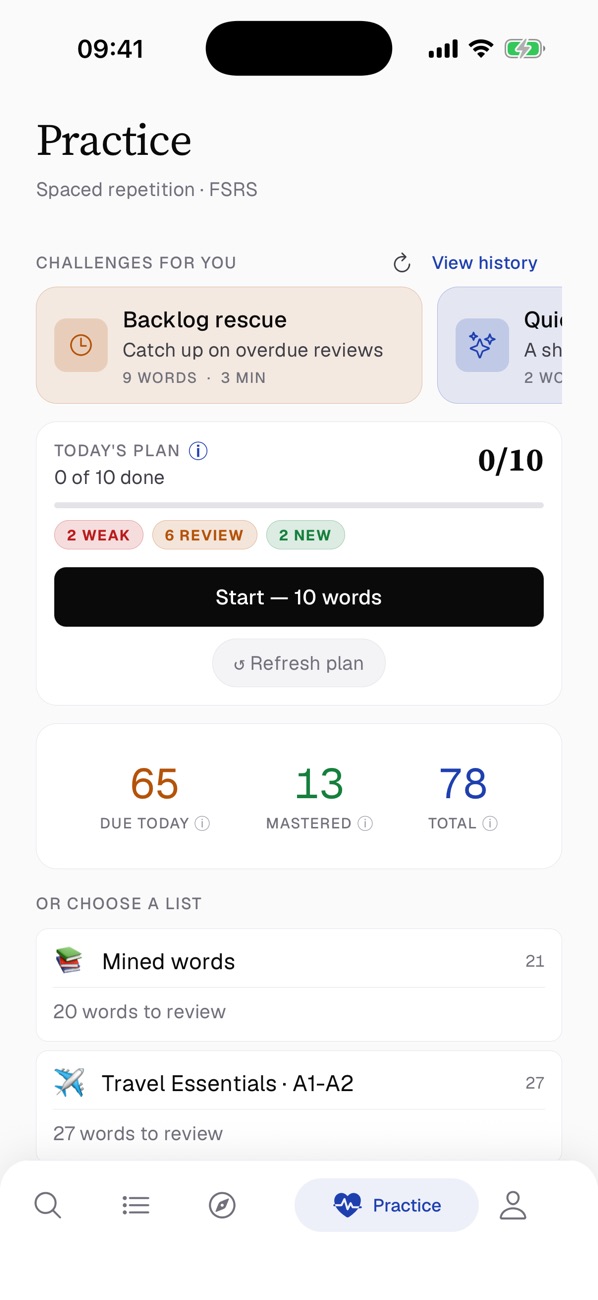
In the app: a plan after a week away — 2 weak · 6 due · 2 new.
3 · Where a card comes from
Lexum checks it's a real word in the right language — and suggests a fix when there's a typo.
A word with several meanings is split into senses, the most used first. Idioms are recognised as idioms.
Translation, pronunciation, part of speech and a CEFR level, judged by how common the word is and how it's built.
A definition in your own language and two example sentences.
Another model rereads the card; spelling and grammar go through LanguageTool or Hunspell. What fails is rewritten or waits for a person.
The checked card is kept. The next person who looks the word up gets it at once — and a fixed mistake is fixed for everyone.
Spot something wrong? “Report a wrong translation” is on every card, and a person reads every report.
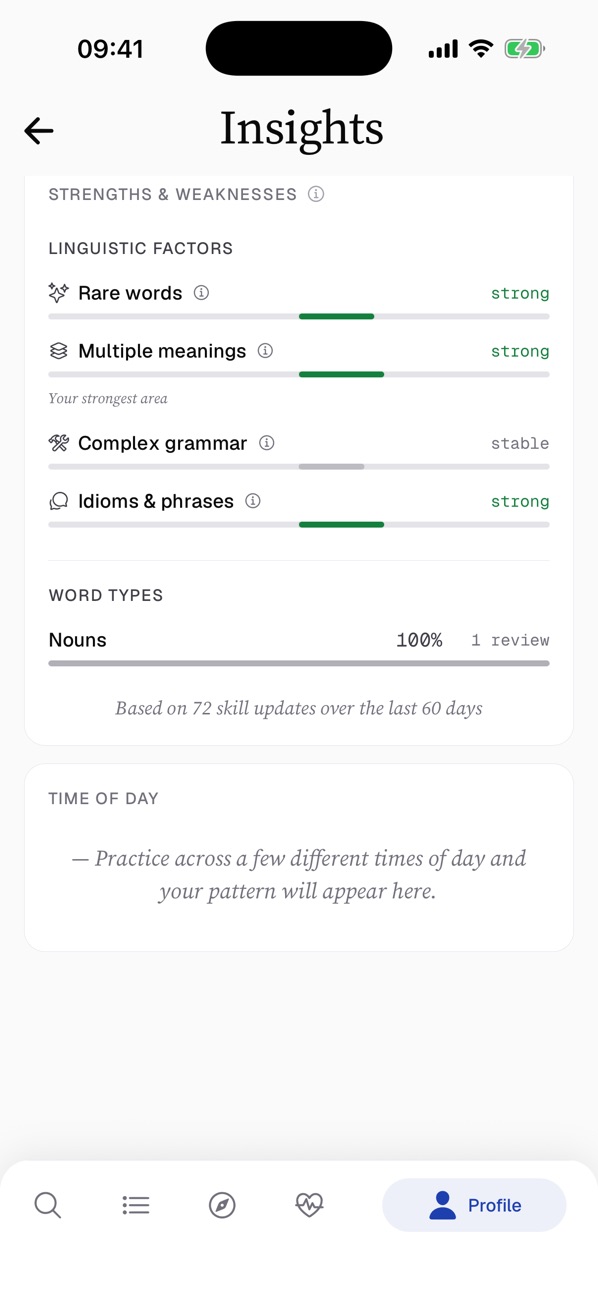
4 · What Lexum notices
Rare words, words with several meanings, tricky grammar, idioms — Lexum tracks how you do with each kind, estimates your level separately for recognising a word and for recalling it, and turns your week into a short written summary.
Basic charts are free; Pro adds the per-language breakdowns and the full history.
Where words come from
Languages
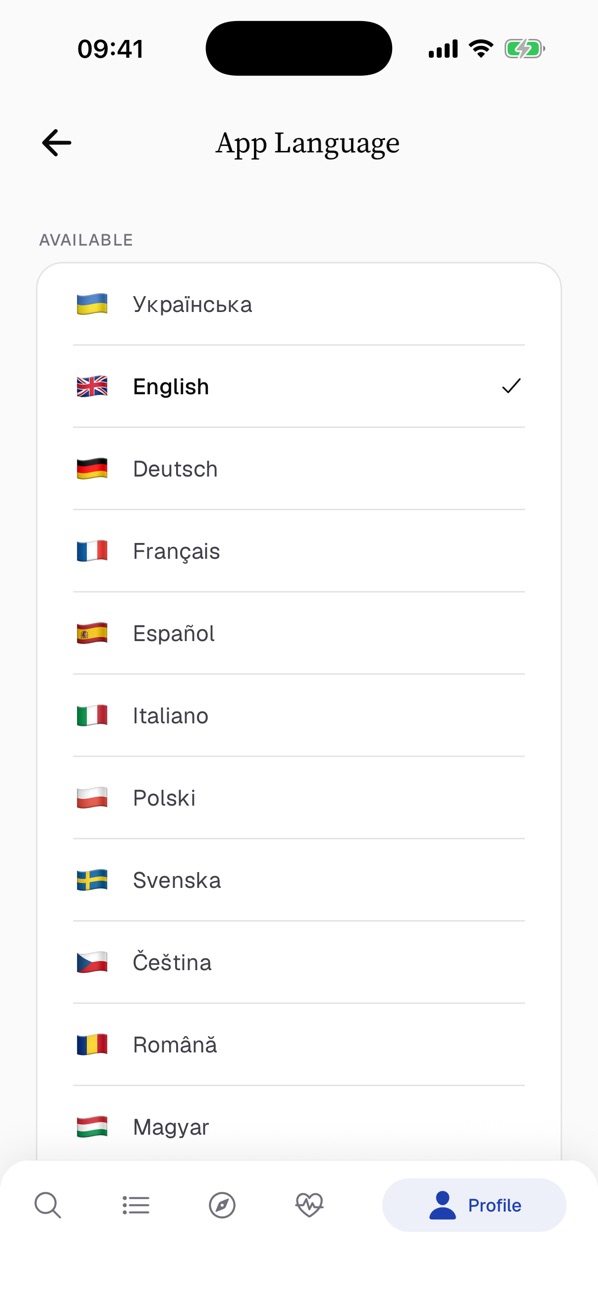
The interface, the definitions and the explanations come in your own language. You can translate between any of them.
The ready-made collections are English → Ukrainian for now; more pairs are on the way.
It works best once you can read a little: Breakdown picks words at your level, and the collections start at A1. If you're starting from zero, a course will serve you better first.
A translator answers and forgets you. A course teaches its own words, not yours. A flashcard app makes you build every card by hand. Lexum makes the card from the word you just met, in the meaning it had there, and schedules it for you.
| Translator | Course | Flashcards | Lexum | |
|---|---|---|---|---|
| Your own words | ● | — | ● | ● |
| The meaning in context | — | ● | — | ● |
| Cards made for you | — | ● | — | ● |
| Brought back on time | — | ● | ● | ● |
The core is free. Pro raises the daily limits and adds the deeper tools; it unlocks when Lexum reaches the App Store and Google Play.
Free and Pro →We’re testing Lexum with a small group first. Join early and start building vocabulary that lasts.
First 50 users become Founding Users.
A free month of Pro at launch • Higher limits than Pro • A Founding badge • New features first
What Founding Users get